
Summary and examples
Often a function is given in explicit form, that is to say in the form  . When we want to differentiate
  to
to  we use the table of standard functions or the product, quotient or chain rule, or a combination of these methods.
It also occurs that a function is not in explicit form  but in implicit form, that is to say in the form
  . In this case we might want to define a derivative of , but we do not know immediately how to do this. We discuss this topic here.
In this context, it is useful to realize that we would have to actually write  . After all, is a function of . But mostly (mathematicians are often lazy) we write instead or
  which is a shorthand notation.
To show how to differentiate an implicit function, we look at some examples.
Example 1
Determine the derivative of when this is given in explicit form:

We do not have the function available in explicit form (which can be found quite easily in this case, see later)), we need to apply implicit differentiation.
We notice that the formula which has to be differentiated is a product of two functions of . We call one function  and the other
  . Now we apply the product rule:
![h'(x)=[xy(x)]'=1.y(x)+x.y'(x)](https://4mules.nl/wp-content/ql-cache/quicklatex.com-837c8a218f37a8810ef25d88a396e62c_l3.png "Rendered by QuickLaTeX.com")
So we can write:
![[xy(x)]'=0\Rightarrow y(x)+x.y'(x)=0\Rightarrow y'(x)=-\displaystyle\frac{y(x)}{x}](https://4mules.nl/wp-content/ql-cache/quicklatex.com-56d2be4e95f8096b74031f73e6b8ef8f_l3.png "Rendered by QuickLaTeX.com")
Unfortunately, the derivative  is available as a function of which we do not know.
As mentioned earlier, the implicit expression:

can also be written explicitly:

When we substitute in the derivative above, we get:
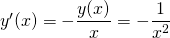
This a result which we would have expected.
Example 2
The following example (as more examples) is taken from the book Sydsaeter and Hammond: Essential Mathematics for Economic Analysis (4th ed).
Determine the derivative in the point  of the graph of the implicitly given function of :

We notice that it is not easy (and maybe impossible) to deduce an explicit function from this implicit function.
Yet we want to find the derivative in the given point, and thus we have to use implicit differentiation.
![[y^3+3x^2y]'=[y^3]'+3[x^2y]'](https://4mules.nl/wp-content/ql-cache/quicklatex.com-52abdff9a2f15c35982135698955cda3_l3.png "Rendered by QuickLaTeX.com")
The second term is not difficult to differentiate. The first term requires some explanation. We do not have to differentiate itself – this would yield  - but a function of namely
  . In such cases we have to apply the chain rule:
![[y^3]'=3y^2.y'](https://4mules.nl/wp-content/ql-cache/quicklatex.com-98a620c1cb5b0d486aa889b32ef456ba_l3.png "Rendered by QuickLaTeX.com")
Just to understand this, look at a similar example. We know that the derivative of  equals
  , and thus, when we want to differentiate the derivative of
  than applying the chain rule yields:
![[y^3]'=[(\ln(x))^3]'=3(\ln(x))^2.[\ln(x)]'=3y^2y'](https://4mules.nl/wp-content/ql-cache/quicklatex.com-5dd64ca11ccf6e3cb005b3076d6f0602_l3.png "Rendered by QuickLaTeX.com") .
.
So we get:
![[y^3+3x^2y]'=[y^3]'+3[x^2y]=3y^2y'+6xy+3x^2y'](https://4mules.nl/wp-content/ql-cache/quicklatex.com-d328b74fec6df041e71256f3210daf20_l3.png "Rendered by QuickLaTeX.com")
and have to solve from the equation:

which results in the derivative:
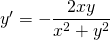
Thus, in the point we find 
Example 3
The following formula describes the graph of a circle with center  and radius
  :
:

In which points of the circle does the tangent line have a slope equal to  (meaning that the angle between tangent line and
  -axis is
  degrees)?
In order to find the slope we have to differentiate the implicit function:
 or
or

A slope equal to means that  or
or  or
or  .
.
If we combine this with the equation we find  , so
, so  or
or  .
.
The points we have been looking for are 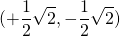 ), or
), or 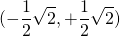 .
.
Just check this in the figure of the circle.