

Summary and examples
In general the following derivatives of standard functions are assumed to be known.
 |  | |
|---|---|---|
| a. |  |  |
| b. |  |  |
| c. |  |  |
| d. | |  |
| e. |  | |
| f. |  |  |
| g. |  |  |
| h. |  |  |
Furthermore we have the following rules:
If:
i. 
then:

and if:
j. 
then:

In the following examples we show how these rules are applied.
Example 1

so:

(according to a)
Example 2

so:

(according to a, i)
Example 3

so:

(according to c)
Example 4

so:

(according to e, i)
Example 5

so:

(according to f, i)
Example 6

so:
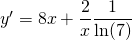
(according to a, h, i, j)
Example 7

so:

(according to a, f, i, j)
Now some more difficult examples.
Example 8
Find the derivative of:
![y=\sqrt[4]{x^3}](https://4mules.nl/wp-content/ql-cache/quicklatex.com-2ee093fc1679840db4cf8a6b8045af09_l3.png "Rendered by QuickLaTeX.com")
At first sight this function is not in the table of standard functions. However we can rewrite the function:
![y=\sqrt[4]{x^3}=x^{\frac{3}{4}}](https://4mules.nl/wp-content/ql-cache/quicklatex.com-1f2992d08b3236685959acb10a40298e_l3.png "Rendered by QuickLaTeX.com")
and thus rule a. can be applied with:

So:
![y'=\displaystyle\frac{3}{4}x^{\frac{3}{4}-1}=\displaystyle\frac{3}{4\sqrt[4]{x}}](https://4mules.nl/wp-content/ql-cache/quicklatex.com-a701813d2704eab8503a52f58b530dff_l3.png "Rendered by QuickLaTeX.com")
Example 9
Differentiate:

This function can be written as:

and thus:
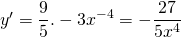
(according to a,i)
Example 10
A difficult function seems:

but also this function can be rewritten and be differentiated easily:

and thus:
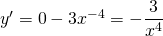
(according to a, b, j)
Example 11
Differentiate the following function:

We can rewrite the function as follows:

and thus:

(according to a, i)
Example 12
Finally we want to differentiate the following function:
![y=\displaystyle\frac{1}{\sqrt[5]{x^2}}](https://4mules.nl/wp-content/ql-cache/quicklatex.com-0d584922379f7bc611dee557368ccb4e_l3.png "Rendered by QuickLaTeX.com")
We can rewrite it as follows:
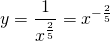
The derivative is:
![y'=-\displaystyle\frac{2}{5}x^{-\frac{7}{5}}=-\displaystyle\frac{2}{5x\sqrt[5]{x^2}}](https://4mules.nl/wp-content/ql-cache/quicklatex.com-99f0dd1520dc354d4792d24d4c1b81e1_l3.png "Rendered by QuickLaTeX.com")